![Reblog this post [with Zemanta]](https://lh3.googleusercontent.com/blogger_img_proxy/AEn0k_t0UWO7vsDFSiDzUfWiuxkw6aDRcqtuSHww-tWKM_CsQmwY5QVFO2vrQ0liEyzW7U2sXIk1CZMq0LKcRF91TPVQ5LlM5xI4-EzRAf8wVxdUBEHv35v8PPixwU-kTfUOZfbP5iHHvWUB0-qdMdhLwuw0=s0-d)

Showing posts with label Mongolia. Show all posts
Showing posts with label Mongolia. Show all posts
Friday, November 7, 2008
Correction
I made a mistake in my last post in regards to the independence of Mongolia. I erroneously said it was in 1991 but, as an anonymous reader has pointed out, Mongolia was declared independent in 1911. I definitely had it stuck in my head for some reason that it was 1991, and after looking at some of the books and websites I have been reading lately, it seems that I was associating the pull out of the Soviet Union with independence in Mongolia --- totally my mistake. I've been reading a lot lately about the resurgence of Buddhism in Mongolia and often the phrase "since 1991" and "since the early 1990's" is employed. I am new to Mongolian studies and will certainly make many mistakes. I always appreciate comments, suggestions, and corrections--- of course, I also hope that these would come in a (less hostile) constructive manner.

This summer...
I just realized that I never finished the stories of this summer's travels. I'm really busy these days so I can't really give the rest of those experiences justice on this blog.
I'll just add some highlights here...
Mongolia:
After wrapping up in the field we said our goodbyes and headed back to Ulaan Baatar where I stayed a few more days. We had a few more get-togethers with the friends we made on the trip, both Mongolian and Western, and just had a lovely time. I really love Ulaan Baatar, despite the first impressions I had. Crumbling soviet-era apartment blocks with gers bundled in between, both bizarre and charming. Of course, seeing the city with my new friends really put it in a different light.
I was extremely lucky to be present for a special time in Mongolia--- the night they won their first Olympic Gold Medal-- ever! It happened to be an evening I was spending alone so I wandered to Sukhbaatar Square where I assumed there would be celebrations. Sure enough there were hundreds gathered and it soon turned into a huge party. Everyone was chanting Monguul! Monguul! (Mongolia! Mongolia!) there were fireworks and at one point the Prime Minister came out, flanked by a band, and spoke to the crowd before the band played their national anthem. Mongolia has only been independent since 1991-- this was a very big moment for them. I'm so glad I was there! I made some new friends at the square that night and spent the rest of the evening with them, celebrating--- a night I won't forget.
 Flags were out en masse.
 The Prime Minister and entourage in front of the Chinggis Khan statue.
 Fireworks over Sukhbaatar Square.
China:
I took an early flight out of Mongolia to Beijing, glad there were clear skies so I can watch Mongolia roll away as we flew out. I hope it's not long before I go back again.
My friend Laura, one of my best friends from college landed a job working at the Beijing Olympics. This was a great opportunity for me to return to the city and see it at a tremendously exciting time. I was really impressed with the way Beijingers came together to put the city's best foot forward. Businesses had new signs, buildings were freshly painted, and tourist help kiosks had been erected everywhere. Cheerful old men and women (without a lick of English), sporting brightly colored vests that said "Olympic Volunteer", hovered around on the streets, ready for anything. I made sure to ask them directions, even though I knew where I was going, as it so pleased them to help out.
I stayed with Laura, in the apartment her job provided near Sanlitun. Sadly, we both got very ill my second day in so I spent most of my time that week in the hotel room-- I saw a doctor in Chiang Mai-- turns out I had dysentery!!! Yes, the disease that kills off members of your wagon train in the old "Oregon Trail" computer game. Needless to say, it is as unpleasant as it sounds. I still wrestled up the energy to see my friend Jade, a cool chick I met on my North Korea trip last year, and to go to my first Olympic competition, which was really exciting. Laura scored free tickets to the synchronized swimming finals, in the Water Cube. The Olympic grounds were expansive and the Water Cube and Birds Nest were impressive up-close. It was fun walking around the grounds, soaking up the excitement, and watching the medal ceremony for our competition, with the gold going to Russia.
 The entrance to the Water Cube.
 Laura and I in front of the Bird's Nest.
 Russia gets the gold in synchronized swimming (you can blame Canada for this bizarre sport).
Thailand: Al met me at the Chiang Mai airport and brought me home the next day, only to bring me to the train station less than 24 hours later for the last leg of my summer travels. I had months earlier planned to meet my friend Amber, a fellow English teacher in Korea, on the islands somewhere during her once a year break (hagwons work you to the bone). These plans were made before the Beijing plans so I didn't realize how stretched out and tired I would be. I caught an overnight train to Bangkok, waited around a few hours, and then hopped on a flight to Koh Samui, where she had arrived two days earlier and booked some beach side bungalows. It was a great way to wind down after all of my adventures. We lazed around all day on beaches, both on Samui and Koh PaNgan, enjoyed fantastic seafood and tropical drinks, and danced with a bizarre group of Spaniards. Good times.
 Ko Samui sunset (click for larger view)
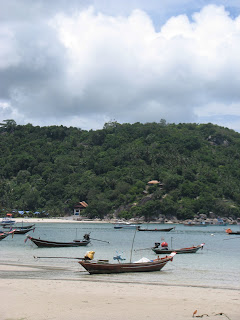 Boats in the bay, Ko PaNgan
 Me, enjoying fresh coconut.
It was good to get back to Uttaradit after all that, to start settling in to my new home there. I'm glad I had six weeks off before starting my new job. This summer shook my life up like a snowglobe, now everything's falling into place again-- until the next time!
![Reblog this post [with Zemanta]](https://lh3.googleusercontent.com/blogger_img_proxy/AEn0k_ujGaX-UU2kcRc7yMyzSwfbOAJz53fyvgeiWIdWbex6LihMsGc9npkRIeQPP2u97Tp4wQ75IfLa9gGm-R9BZBH-bTcvL4TGTTPBLcqqrt0NqIN2sYuTrybUUjVSbjOAnmuwsVpF6yXSytKtCaROYrI=s0-d)
I'll just add some highlights here...
Mongolia:
After wrapping up in the field we said our goodbyes and headed back to Ulaan Baatar where I stayed a few more days. We had a few more get-togethers with the friends we made on the trip, both Mongolian and Western, and just had a lovely time. I really love Ulaan Baatar, despite the first impressions I had. Crumbling soviet-era apartment blocks with gers bundled in between, both bizarre and charming. Of course, seeing the city with my new friends really put it in a different light.
I was extremely lucky to be present for a special time in Mongolia--- the night they won their first Olympic Gold Medal-- ever! It happened to be an evening I was spending alone so I wandered to Sukhbaatar Square where I assumed there would be celebrations. Sure enough there were hundreds gathered and it soon turned into a huge party. Everyone was chanting Monguul! Monguul! (Mongolia! Mongolia!) there were fireworks and at one point the Prime Minister came out, flanked by a band, and spoke to the crowd before the band played their national anthem. Mongolia has only been independent since 1991-- this was a very big moment for them. I'm so glad I was there! I made some new friends at the square that night and spent the rest of the evening with them, celebrating--- a night I won't forget.
 Flags were out en masse.
 The Prime Minister and entourage in front of the Chinggis Khan statue.
 Fireworks over Sukhbaatar Square.
China:
I took an early flight out of Mongolia to Beijing, glad there were clear skies so I can watch Mongolia roll away as we flew out. I hope it's not long before I go back again.
My friend Laura, one of my best friends from college landed a job working at the Beijing Olympics. This was a great opportunity for me to return to the city and see it at a tremendously exciting time. I was really impressed with the way Beijingers came together to put the city's best foot forward. Businesses had new signs, buildings were freshly painted, and tourist help kiosks had been erected everywhere. Cheerful old men and women (without a lick of English), sporting brightly colored vests that said "Olympic Volunteer", hovered around on the streets, ready for anything. I made sure to ask them directions, even though I knew where I was going, as it so pleased them to help out.
I stayed with Laura, in the apartment her job provided near Sanlitun. Sadly, we both got very ill my second day in so I spent most of my time that week in the hotel room-- I saw a doctor in Chiang Mai-- turns out I had dysentery!!! Yes, the disease that kills off members of your wagon train in the old "Oregon Trail" computer game. Needless to say, it is as unpleasant as it sounds. I still wrestled up the energy to see my friend Jade, a cool chick I met on my North Korea trip last year, and to go to my first Olympic competition, which was really exciting. Laura scored free tickets to the synchronized swimming finals, in the Water Cube. The Olympic grounds were expansive and the Water Cube and Birds Nest were impressive up-close. It was fun walking around the grounds, soaking up the excitement, and watching the medal ceremony for our competition, with the gold going to Russia.
 The entrance to the Water Cube.
 Laura and I in front of the Bird's Nest.
 Russia gets the gold in synchronized swimming (you can blame Canada for this bizarre sport).
Thailand: Al met me at the Chiang Mai airport and brought me home the next day, only to bring me to the train station less than 24 hours later for the last leg of my summer travels. I had months earlier planned to meet my friend Amber, a fellow English teacher in Korea, on the islands somewhere during her once a year break (hagwons work you to the bone). These plans were made before the Beijing plans so I didn't realize how stretched out and tired I would be. I caught an overnight train to Bangkok, waited around a few hours, and then hopped on a flight to Koh Samui, where she had arrived two days earlier and booked some beach side bungalows. It was a great way to wind down after all of my adventures. We lazed around all day on beaches, both on Samui and Koh PaNgan, enjoyed fantastic seafood and tropical drinks, and danced with a bizarre group of Spaniards. Good times.
 Ko Samui sunset (click for larger view)
 Boats in the bay, Ko PaNgan
 Me, enjoying fresh coconut.
It was good to get back to Uttaradit after all that, to start settling in to my new home there. I'm glad I had six weeks off before starting my new job. This summer shook my life up like a snowglobe, now everything's falling into place again-- until the next time!
Wednesday, October 1, 2008
Mongolia -Ishee's Home
One of the most special nights while we were out in the field is when we were invited for dinner at Ishee's home.
Ishee was one of the few archaeology students who grew up in the countryside and he always seemed to outdo the other guys in all of the "manly" tasks I mentioned before, from horse riding and wrestling, to rock throwing and goat killing. He was also one of the most friendly and welcoming of the crew.
His family's ger camp was just over an hour's drive away so we got to stop work early one Friday and head over for a day of fun and feasting.
I'm really glad we got to see what ger life was like. They had two gers and set up an extra tent for us to chill out in for the evening. Ishee's parents were there as well as his older brother and his brothers wife and young son. I'm not totally sure, but I think they all lived there. It is also common for people to live part time in the city and go into the country for extended periods to help out with livestock etc. Another family had their ger set up in the valley not too far away, which is typical for security.
 Old Russian movies on TV.
 Checking out the digs.
If you don't know much about Mongolia, you may not have known that even today, many Mongolians are nomads. Their gers can be taken apart and loaded on carts within a few hours so that they can find better pastures for their livestock (almost exclusively goats, sheep, and horses, and sometimes camels). They are not constantly moving, usually only once or twice a year (summer and winter pastures), and they go back to the same spots often. Ishee's family had a generator so they can watch TV and they have all the normal household goods you would think of, just more compact in some cases (like the stove) or organized more frugally (for instance, a lot of items were stuck inbetween the wooden slats and the felt covering). It was all very cozy although I wonder what it's like in the winter--- Mongolia's temperatures can drop to -30!
We had the best meal that night--- heaps of mutton that had been slow cooked over hot rocks. My mouth waters even now, thinking about it. The met is cut up and put into a large silver bowl which is then passed around. Pick out your favorite cut and eat with your hands (and a knife if you have one). Works for me!
 Tea, yogurt, sweet bread, and candies.
After that of course, the vodka. Ishee's father was in charge of pouring while Ishee passed out the cups. Everyone had more than their fair share. The rest of the night was spent socializing before heading out to the first of our ger camp parties.
 The passing of the vodka.
 The director, Bill, taking his turn. The senior members of our group were treated to extra cups of vodka.
It was lovely of his family to invite such a large group of clueless foreigners to their home, we all had a wonderful time!
 A perfect rainbow to finish off a truly memorable evening.
![Reblog this post [with Zemanta]](https://lh3.googleusercontent.com/blogger_img_proxy/AEn0k_vdFi_AuUSD2AW9O_8U8wU6GXGAnq8mTa-5W3ZO2aRv3y0E96nEbnjAqD1QPO-wc31pcBgQsF8tMcmJqVWfiSYSPb1LtggDvW59E3ff38fwtUs4W8JGCaYVyfiNcJCcPdldhgIf4IsCJd-j2iluLLlR=s0-d)
Ishee was one of the few archaeology students who grew up in the countryside and he always seemed to outdo the other guys in all of the "manly" tasks I mentioned before, from horse riding and wrestling, to rock throwing and goat killing. He was also one of the most friendly and welcoming of the crew.
His family's ger camp was just over an hour's drive away so we got to stop work early one Friday and head over for a day of fun and feasting.
I'm really glad we got to see what ger life was like. They had two gers and set up an extra tent for us to chill out in for the evening. Ishee's parents were there as well as his older brother and his brothers wife and young son. I'm not totally sure, but I think they all lived there. It is also common for people to live part time in the city and go into the country for extended periods to help out with livestock etc. Another family had their ger set up in the valley not too far away, which is typical for security.
 Old Russian movies on TV.
 Checking out the digs.
If you don't know much about Mongolia, you may not have known that even today, many Mongolians are nomads. Their gers can be taken apart and loaded on carts within a few hours so that they can find better pastures for their livestock (almost exclusively goats, sheep, and horses, and sometimes camels). They are not constantly moving, usually only once or twice a year (summer and winter pastures), and they go back to the same spots often. Ishee's family had a generator so they can watch TV and they have all the normal household goods you would think of, just more compact in some cases (like the stove) or organized more frugally (for instance, a lot of items were stuck inbetween the wooden slats and the felt covering). It was all very cozy although I wonder what it's like in the winter--- Mongolia's temperatures can drop to -30!
We had the best meal that night--- heaps of mutton that had been slow cooked over hot rocks. My mouth waters even now, thinking about it. The met is cut up and put into a large silver bowl which is then passed around. Pick out your favorite cut and eat with your hands (and a knife if you have one). Works for me!
 Tea, yogurt, sweet bread, and candies.
After that of course, the vodka. Ishee's father was in charge of pouring while Ishee passed out the cups. Everyone had more than their fair share. The rest of the night was spent socializing before heading out to the first of our ger camp parties.
 The passing of the vodka.
 The director, Bill, taking his turn. The senior members of our group were treated to extra cups of vodka.
It was lovely of his family to invite such a large group of clueless foreigners to their home, we all had a wonderful time!
 A perfect rainbow to finish off a truly memorable evening.
Tuesday, September 23, 2008
Desert Disco
I did not expect to do a lot of singing and dancing while in Mongolia-- but it turned out to be one of my favorite parts!
We had two parties at the tourist ger camp, which was a few miles away. It consisted of a few lovely rows of gers, a restaurant ger, and a bathhouse. The well we got our water from was nearby.
 Baga Gazaryn Chuluu Tourist Ger Camp
 Restaurant and bathhouse.
 Inside the restaurant.
For our parties the whole camp piled on top of each other in our five vans and poured into the restaurant ger. The tables were moved to the side and Bill (our director) was kind enough to get the first round of beers and vodka. The lights were dimmed, track lighting was flipped on, and then a bizarre mix of five year old American pop, random Europop, and Mongolian hits were played while we all danced our butts off. I loved it.
 Cheers!
The ger camp closed us down by midnight so we took the party back to our camp --- again, piled on top of each other in the jeeps, except this time driving off road in the dark! Back at camp the vans would park in a circle, turn on their blinkers for "disco lights" and blare the music. Then we'd continue the party, dancing in the sand.
After returning to UB (the capital of Mongolia, Ulaan Baatar) we had a few after-parties. Karaoke night was the most fun. I normally hate karaoke but our group is such a bunch of fun loving people its hard to be self conscious and not get into it! I never would have guessed the building we went to for karaoke was even in use-- it looked abandoned from the outside. They took us up some dark and uneven stairs into a hallway that surprisingly held a dimly lit bar. Rooms shooting off from the hall were private karaoke rooms with couches and everything else you would expect. Great night! Seeing a bunch of manly Mongolian men singing "It's Raining Men" is quite a sight and I never thought I'd have the opportunity to sing the one and only Russian song I know!
 Boldoo, Saadia, Me, Alyson, and Emma.
Well, obviously, I had a great time with the BGC crew!
Next post... Mongolia: the Land of Manly Skill....
We had two parties at the tourist ger camp, which was a few miles away. It consisted of a few lovely rows of gers, a restaurant ger, and a bathhouse. The well we got our water from was nearby.
 Baga Gazaryn Chuluu Tourist Ger Camp
 Restaurant and bathhouse.
 Inside the restaurant.
For our parties the whole camp piled on top of each other in our five vans and poured into the restaurant ger. The tables were moved to the side and Bill (our director) was kind enough to get the first round of beers and vodka. The lights were dimmed, track lighting was flipped on, and then a bizarre mix of five year old American pop, random Europop, and Mongolian hits were played while we all danced our butts off. I loved it.
 Cheers!
The ger camp closed us down by midnight so we took the party back to our camp --- again, piled on top of each other in the jeeps, except this time driving off road in the dark! Back at camp the vans would park in a circle, turn on their blinkers for "disco lights" and blare the music. Then we'd continue the party, dancing in the sand.
After returning to UB (the capital of Mongolia, Ulaan Baatar) we had a few after-parties. Karaoke night was the most fun. I normally hate karaoke but our group is such a bunch of fun loving people its hard to be self conscious and not get into it! I never would have guessed the building we went to for karaoke was even in use-- it looked abandoned from the outside. They took us up some dark and uneven stairs into a hallway that surprisingly held a dimly lit bar. Rooms shooting off from the hall were private karaoke rooms with couches and everything else you would expect. Great night! Seeing a bunch of manly Mongolian men singing "It's Raining Men" is quite a sight and I never thought I'd have the opportunity to sing the one and only Russian song I know!
 Boldoo, Saadia, Me, Alyson, and Emma.
Well, obviously, I had a great time with the BGC crew!
Next post... Mongolia: the Land of Manly Skill....
Wednesday, September 17, 2008
One more....
Another Mongolian song I really like. This video has some cool ger scenes too. (Ger= Mongolian house, rhymes with "bear").
Traditional Music
I loved the traditional music that was played in the vans sometimes on the way from camp to site. Listening to this music and watching Mongolia's incredible landscape go by gave me that tingly, alive feeling --- "wow, I'm really in Mongolia".
Here's a good representative of the music. A sad song! The ruined temple, (called Sum Khok Burd), the singer is sitting in, was a few hours from our site. We visited there one weekend and took showers in the nearby town.
Listen to how she rolls her "R's". I cannot for the life of me reproduce this which makes me wonder if I'll ever be able to learn Mongolian!

Me at Sum Khok Burd
Here's a good representative of the music. A sad song! The ruined temple, (called Sum Khok Burd), the singer is sitting in, was a few hours from our site. We visited there one weekend and took showers in the nearby town.
Listen to how she rolls her "R's". I cannot for the life of me reproduce this which makes me wonder if I'll ever be able to learn Mongolian!

Me at Sum Khok Burd
Mongolia -- The Basics
On site, three meals a day were provided for us by the lovely Jagaa and Zola, the only two Mongolian women present on this project. (There are female Mongolian archaeologists on other projects)
Breakfast alternated between rice porridge and cream of wheat. Gomber was also always present--- sort of like a funnel cake without the powdered sugar. Instant coffee and tea rounded it out.

Gomber frying. Fresh gomber with honey is fantastic! (photo by Ian Nelson)
Lunches and dinners were always a goat dish. Goat dumplings, goat soup, goat and fried noodles, goat and veggies, goat and macaroni salad...... you get the picture.
On two occasions we had mutton which was a welcome break--- so tasty!
Veggies are not so easy to come by in the Gobi so they relied on things that were easy to store and supplemented it with whatever passing nomads were selling or what could be found in the nearest town on the weekends. (which wasn't much) Usually we had potatoes, carrots, cabbage, red and green peppers, and pickles. I would have killed for a tomato.
I really didn't mind the food, in fact some of the dishes were delicious! The problem was the tremendous portion size. I could never clear my plate and the cooks were quite unhappy with you if they saw you dump it. Many plans were devised to avoid their disdain. Asking for a smaller portion had no effect whatsoever, if you were brave enough to try.
A goat was brought in almost daily, purchased from one of the nomad families nearby. Ishee, one of the archaeologists who was from our region, had the task of dispatching it. Traditionally, Mongolians slaughter an animal by cutting a small slit in its chest, reaching in, and stopping its heart with his hand. I'm not kidding you. Ishee, impressively, did this for the camp. Most of the goat was used, although the Mongolians eat a lot of parts the Westerners weren't too keen on. The cooks cooked meals based on Western tastes and made separate dishes with the intestines, etc, that just the Mongolians ate. Worked for me.
For snacks, I quickly learned it was essential to have a hoard of candy and sodas in your tent. Not just for you, but also to bring out and share and/or bribe people with. Trips to town and tourist camps were an opportunity to replenish. If you had vodka, your popularity would increase for sure.
Vodka. I thought I knew things about Mongolia before I came, but I didn't know about the prominence of vodka in their culture. Any occasion could potentially call for vodka. When one of the vans broke down a bottle of vodka was pulled out and a blinker used as a glass while they waited for help. All of our "parties" involved copious amounts of vodka. When I told one of the guys that back home I drink, but not vodka, he incredulously asked "but then, what do you drink?" Hahaha.
Luckily, the way they distribute it allows you to take a decent break between drinks. One person pours into a cup (I loved the antique cups that we saw at Ishee's ger-- more on that later), he then passes that cup to you with his right hand. You accept with your right hand and shoot it or sip it, your choice (at least, they didn't harass us if we couldn't shoot it). You then hand it back and he does the same with everyone in the group. Then it all starts again-- the larger the group, the longer the break. If you don't want to drink, dip your pinky in and flick it three times (to the earth, the wind, and the sky?) and then return the cup. I really enjoyed this, it made drinking seem more intimate and social.
Well... vodka leads to dancing, which will be the theme of my next post! Stay tuned!

Jagaa, Ishee, and Zola
Breakfast alternated between rice porridge and cream of wheat. Gomber was also always present--- sort of like a funnel cake without the powdered sugar. Instant coffee and tea rounded it out.

Gomber frying. Fresh gomber with honey is fantastic! (photo by Ian Nelson)
Lunches and dinners were always a goat dish. Goat dumplings, goat soup, goat and fried noodles, goat and veggies, goat and macaroni salad...... you get the picture.
On two occasions we had mutton which was a welcome break--- so tasty!
Veggies are not so easy to come by in the Gobi so they relied on things that were easy to store and supplemented it with whatever passing nomads were selling or what could be found in the nearest town on the weekends. (which wasn't much) Usually we had potatoes, carrots, cabbage, red and green peppers, and pickles. I would have killed for a tomato.
I really didn't mind the food, in fact some of the dishes were delicious! The problem was the tremendous portion size. I could never clear my plate and the cooks were quite unhappy with you if they saw you dump it. Many plans were devised to avoid their disdain. Asking for a smaller portion had no effect whatsoever, if you were brave enough to try.
A goat was brought in almost daily, purchased from one of the nomad families nearby. Ishee, one of the archaeologists who was from our region, had the task of dispatching it. Traditionally, Mongolians slaughter an animal by cutting a small slit in its chest, reaching in, and stopping its heart with his hand. I'm not kidding you. Ishee, impressively, did this for the camp. Most of the goat was used, although the Mongolians eat a lot of parts the Westerners weren't too keen on. The cooks cooked meals based on Western tastes and made separate dishes with the intestines, etc, that just the Mongolians ate. Worked for me.
For snacks, I quickly learned it was essential to have a hoard of candy and sodas in your tent. Not just for you, but also to bring out and share and/or bribe people with. Trips to town and tourist camps were an opportunity to replenish. If you had vodka, your popularity would increase for sure.
Vodka. I thought I knew things about Mongolia before I came, but I didn't know about the prominence of vodka in their culture. Any occasion could potentially call for vodka. When one of the vans broke down a bottle of vodka was pulled out and a blinker used as a glass while they waited for help. All of our "parties" involved copious amounts of vodka. When I told one of the guys that back home I drink, but not vodka, he incredulously asked "but then, what do you drink?" Hahaha.
Luckily, the way they distribute it allows you to take a decent break between drinks. One person pours into a cup (I loved the antique cups that we saw at Ishee's ger-- more on that later), he then passes that cup to you with his right hand. You accept with your right hand and shoot it or sip it, your choice (at least, they didn't harass us if we couldn't shoot it). You then hand it back and he does the same with everyone in the group. Then it all starts again-- the larger the group, the longer the break. If you don't want to drink, dip your pinky in and flick it three times (to the earth, the wind, and the sky?) and then return the cup. I really enjoyed this, it made drinking seem more intimate and social.
Well... vodka leads to dancing, which will be the theme of my next post! Stay tuned!

Jagaa, Ishee, and Zola
Wednesday, September 10, 2008
Mongolia-- weather
Well we were in the Gobi so you can guess it.... hot and dry!
I found it to be pretty reasonable. In Thailand the heat and humidity is unbearable and even the smallest activity leaves you dripping in sweat. The 0% humidity in Mongolia made for much more pleasant working conditions. We usually had a nice breeze as well (although not ideal when you're sifting the dirt)! Most days it was bright and sunny which just added to the natural beautiful scenery at BGC. It did get cool at night though and one night I just couldn't get warm, even with my clothes on, mummy sleeping bag drawn tight, and all of my gear piled on top of me!
Three days in we had a really fantastic storm. It's funny because we watched it come in for some time after dinner--- great lightning show! Most of us were still chilling out by the kitchen tent when it hit so we retreated to the lab tent as a deluge of rain came down on us. The rain was soon joined by marble sized hail and then what was a trickle of water running on the ground turned into a flood! It only went up to our calves but, never having been in a flood, and being in the middle of nowhere-- I was scared! We rushed to get the artifact boxes off the ground and worried about our tents and belongings. Trying to run outside or to the rocks was pointless as our headlamps just reflected off the rain and the floodwaters were so cold it hurt your legs to stand and walk in it a lot anyway.
I don't think it lasted too long before it began to calm a bit. At this point the camp vans were beeping their horns outside and flashing lights so we all jumped in for shelter. The tourist ger camp, a few miles away was nice enough to house us for the night. The next day we got to inspect the damage and although a lot of tents were messed up and everything was soaked it was all back in shape by noon. That dry heat came back in full force and everyone was really good about making the rounds of everyone's tents to help with repairs. My tent suffered one broken pole which caused a partial collapse-- but back to new in no time.
Of course, in retrospect it's exciting, but at the time I wondered what I was doing there!

Sometimes the lightning seemed to stretch across the whole desert--- but of course I didn't manage those shots!

Me, super excited about floods. (notice the skulls behind me)
I found it to be pretty reasonable. In Thailand the heat and humidity is unbearable and even the smallest activity leaves you dripping in sweat. The 0% humidity in Mongolia made for much more pleasant working conditions. We usually had a nice breeze as well (although not ideal when you're sifting the dirt)! Most days it was bright and sunny which just added to the natural beautiful scenery at BGC. It did get cool at night though and one night I just couldn't get warm, even with my clothes on, mummy sleeping bag drawn tight, and all of my gear piled on top of me!
Three days in we had a really fantastic storm. It's funny because we watched it come in for some time after dinner--- great lightning show! Most of us were still chilling out by the kitchen tent when it hit so we retreated to the lab tent as a deluge of rain came down on us. The rain was soon joined by marble sized hail and then what was a trickle of water running on the ground turned into a flood! It only went up to our calves but, never having been in a flood, and being in the middle of nowhere-- I was scared! We rushed to get the artifact boxes off the ground and worried about our tents and belongings. Trying to run outside or to the rocks was pointless as our headlamps just reflected off the rain and the floodwaters were so cold it hurt your legs to stand and walk in it a lot anyway.
I don't think it lasted too long before it began to calm a bit. At this point the camp vans were beeping their horns outside and flashing lights so we all jumped in for shelter. The tourist ger camp, a few miles away was nice enough to house us for the night. The next day we got to inspect the damage and although a lot of tents were messed up and everything was soaked it was all back in shape by noon. That dry heat came back in full force and everyone was really good about making the rounds of everyone's tents to help with repairs. My tent suffered one broken pole which caused a partial collapse-- but back to new in no time.
Of course, in retrospect it's exciting, but at the time I wondered what I was doing there!

Sometimes the lightning seemed to stretch across the whole desert--- but of course I didn't manage those shots!

Me, super excited about floods. (notice the skulls behind me)
Saturday, September 6, 2008
Mongolia-- the work!
OK, this was a pretty exciting project! If you want a lot of details go to the official website here.
Our volunteer team excavated two burials; first a Xiongnu grave, then a slab burial.
The Xiongnu people are the guys the Chinese built the Great Wall to defend against and they're believed to be the precursors to the Huns (and are sometimes just called the Huns). The grave was roughly 2,000 years old. Bill and Amara (the directors) have been working in this area for six summers, so these graves had already been located and mapped. There are hundreds in the area and only a small sample are excavated. They are easy to recognize as they were always covered with a large number of rocks, which is pretty distinctive on the landscape. Our grave, like most from this period, had been looted so the skeleton was in a jumble. There were still interesting artifacts interred with him though, including parts of his bow and horse bones.
The second feature we excavated was a slab burial which dates even earlier than the Xiongnu-- up to 3,000 years old. The graves are quite spectacular looking but unfortunately ours no longer held anything.
We also had the opportunity to try other tasks such as survey, and lab work. Survey is basically walking around and noting any possible cultural features that might be examined later. Of course, where you walk and how you record things are systematic. It's fun, but I was too out of shape for going up and down the mountains! Flat land for me this summer, but next summer I'll try harder. There are a variety of things you can do in the lab but I was most interested in working with the skeletal material. I haven't had any experience with it since I left grad school and had forgotten so much! It was nice to freshen up my memory again.
In addition, various staff members gave us tutorials on what they specialized in and sometimes let us help out a bit. Through these guys I got to try my hand at sawing human bone for DNA samples, aging a goat by its teeth, measuring the landscape for topographic maps and more-- all new, fun stuff.
Overall, great experience-- wish it went longer!

Xiongnu grave.

Slab burial.

One of our survey areas.
Our volunteer team excavated two burials; first a Xiongnu grave, then a slab burial.
The Xiongnu people are the guys the Chinese built the Great Wall to defend against and they're believed to be the precursors to the Huns (and are sometimes just called the Huns). The grave was roughly 2,000 years old. Bill and Amara (the directors) have been working in this area for six summers, so these graves had already been located and mapped. There are hundreds in the area and only a small sample are excavated. They are easy to recognize as they were always covered with a large number of rocks, which is pretty distinctive on the landscape. Our grave, like most from this period, had been looted so the skeleton was in a jumble. There were still interesting artifacts interred with him though, including parts of his bow and horse bones.
The second feature we excavated was a slab burial which dates even earlier than the Xiongnu-- up to 3,000 years old. The graves are quite spectacular looking but unfortunately ours no longer held anything.
We also had the opportunity to try other tasks such as survey, and lab work. Survey is basically walking around and noting any possible cultural features that might be examined later. Of course, where you walk and how you record things are systematic. It's fun, but I was too out of shape for going up and down the mountains! Flat land for me this summer, but next summer I'll try harder. There are a variety of things you can do in the lab but I was most interested in working with the skeletal material. I haven't had any experience with it since I left grad school and had forgotten so much! It was nice to freshen up my memory again.
In addition, various staff members gave us tutorials on what they specialized in and sometimes let us help out a bit. Through these guys I got to try my hand at sawing human bone for DNA samples, aging a goat by its teeth, measuring the landscape for topographic maps and more-- all new, fun stuff.
Overall, great experience-- wish it went longer!

Xiongnu grave.

Slab burial.

One of our survey areas.
Friday, September 5, 2008
BGC location in Mongolia
This is where I spent 3 weeks volunteering on an archaeological dig.
 clipped from www.csen.org clipped from www.csen.org
|


Mongolia--- characters and setting
I have a lot of stories about Mongolia and my short trips afterward to Beijing and Ko Samui, so I will have to break it up into several posts after the next few days.
Rather than a day-by-day story, I guess I'll start with a description of our site and the people I met there as well as a short blurb on what we were up to.
First of all, I was one of eight volunteers who met in Ulaan Baatar (UB) and were trucked out to site where the excavation had been going on for a few weeks. We were the second phase of volunteers to come through and work with a team of Mongolian and American archaeologists as well as Mongolian students of archaeology. Our volunteer group had a wide range of ages and backgrounds which made for an interesting trip from the get-go.
I arrived in UB (more about the city later) three days early and stayed in the dig apartment while the others trickled in from their flights (and one train). Those of us who had the energy did some sightseeing and sampled our first Mongolian dishes (beer too)!
We were told to be ready to go by 7am the day we had to go to site, but of course, we didn't really take off until almost 10 (this is Asian time-- you get used to it). We embarked in an old Russian jeep and van with drivers Bada and Hashbat for a 6+ hour drive to Baga Gazaryn Chuulu, an area of small rocky outcrops and mountains in the Gobi (map above). No sleeping or reading on this trip though, the roads outside UB are unpaved-- just tracks that are used until they are too rutted and then new tracks are made.
We made it to camp just before sunset and had to hurry to set up our tents before it got dark-- an exciting start.
The camp has three large main tents-- the kitchen, laboratory, and supply tent-- a latrine, a hand washing station, and some chairs and tables. We had to bring our own tents, gear, and water pumps as the water came from a well near the site.
The whole area was rather picturesque especially during sunset when the sun caught the rocks just right.
We woke up at 7 for breakfast and tried to be in the vans by 8 to go to our sites (several were being worked on at one time). We'd come back from 1-3 for lunch and rest and then go out again until 7. It got dark by 9:30-10 so that left a little time for dinner and volleyball or soccer before turning in.
The best thing about this whole trip was working with the Mongolian crew. We would never had been able to get to know local people on any tour in such a way, working and playing together everyday. They were friendly and kind and always tried to help us out as we were adapting to the weather, food, workload, and language and cultural difficulties. They were also just a lot of fun! Always joking around and turning everything into a game or contest. I miss them terribly!

The camp.

BGC rocks (there are tents hidden in there)

My tent at night.

Dinner in UB. This isn't everyone but the core of the people I really connected with. Left to right (with some haziness on spellings) Jargal, Zola, Jagaa, Eugene, Ryan, Amelia, Boldoo, Dukka, Saadia, Daugua, Alyson, Emma, Galdan, Patricia, Dalai, Me, Hatnaa. This was a fantastic night!

The ladies of BGC. Top row: Me, Saadia, Jagaa, Emma, Zola, Patricia Bottom row: Alyson, Amelia, Michelle
Rather than a day-by-day story, I guess I'll start with a description of our site and the people I met there as well as a short blurb on what we were up to.
First of all, I was one of eight volunteers who met in Ulaan Baatar (UB) and were trucked out to site where the excavation had been going on for a few weeks. We were the second phase of volunteers to come through and work with a team of Mongolian and American archaeologists as well as Mongolian students of archaeology. Our volunteer group had a wide range of ages and backgrounds which made for an interesting trip from the get-go.
I arrived in UB (more about the city later) three days early and stayed in the dig apartment while the others trickled in from their flights (and one train). Those of us who had the energy did some sightseeing and sampled our first Mongolian dishes (beer too)!
We were told to be ready to go by 7am the day we had to go to site, but of course, we didn't really take off until almost 10 (this is Asian time-- you get used to it). We embarked in an old Russian jeep and van with drivers Bada and Hashbat for a 6+ hour drive to Baga Gazaryn Chuulu, an area of small rocky outcrops and mountains in the Gobi (map above). No sleeping or reading on this trip though, the roads outside UB are unpaved-- just tracks that are used until they are too rutted and then new tracks are made.
We made it to camp just before sunset and had to hurry to set up our tents before it got dark-- an exciting start.
The camp has three large main tents-- the kitchen, laboratory, and supply tent-- a latrine, a hand washing station, and some chairs and tables. We had to bring our own tents, gear, and water pumps as the water came from a well near the site.
The whole area was rather picturesque especially during sunset when the sun caught the rocks just right.
We woke up at 7 for breakfast and tried to be in the vans by 8 to go to our sites (several were being worked on at one time). We'd come back from 1-3 for lunch and rest and then go out again until 7. It got dark by 9:30-10 so that left a little time for dinner and volleyball or soccer before turning in.
The best thing about this whole trip was working with the Mongolian crew. We would never had been able to get to know local people on any tour in such a way, working and playing together everyday. They were friendly and kind and always tried to help us out as we were adapting to the weather, food, workload, and language and cultural difficulties. They were also just a lot of fun! Always joking around and turning everything into a game or contest. I miss them terribly!

The camp.

BGC rocks (there are tents hidden in there)

My tent at night.

Dinner in UB. This isn't everyone but the core of the people I really connected with. Left to right (with some haziness on spellings) Jargal, Zola, Jagaa, Eugene, Ryan, Amelia, Boldoo, Dukka, Saadia, Daugua, Alyson, Emma, Galdan, Patricia, Dalai, Me, Hatnaa. This was a fantastic night!

The ladies of BGC. Top row: Me, Saadia, Jagaa, Emma, Zola, Patricia Bottom row: Alyson, Amelia, Michelle
Sunday, August 24, 2008
There and Back Again...

I only have time for a short post-- Mongolia was spectacular, of course.
I'm heading to Kho Samui for a few days with a friend and when I'm back I'll finally have time to fill this page up with stories about my month in Mongolia and short stint in Beijing.
Monday, July 21, 2008


Mongolia, Day 1
I didn't think I would have time for computer stuff once I got here but our apartment isn't particularly close to tourist sights so there's not much for us to do after dinner. I'm at the internet cafe on the ground floor of our building. We have just today and tomorrow to get in our sightseeing before heading off to the field site to work. Out of our group of six only two of us had done much reading about what to do in UB so we sort of pointed the way. Personally I don't understand just showing up in a strange city and asking "So what is there to see here?" I'm also the only one who brought a phrase book, which has already proven to be essential here.
Catching a cab to the main square was our first challenge-- turns out my pronunciation of the Mongolian name was terrible. It took us forever to get someone who would take us. There were large groups of people on an arm of the road and all sorts of buses, taxis, and unmarked cars (regular people making extra cash by offering an unofficial taxi). They would pull up and yell out their destinations, at which point people would come running from the waiting crowds to pile in. We just say our destination to anyone who would listen and ended up taking an unoffical cab. From there we stuck to the Lonely Plant's walking tour which allowed us to take in a few temples and monasteries, the Natural History Museum, the main square, and my first Indian-Mexican restaurant. Now we're back and chilling out.
Ulan Bator is more run down than I imagined and even more Soviet looking (architecturally) than I expected. Once you make it out of the central city though you start seeing more typical mongolian-style housing which is much nicer on the eyes.
People are a little reserved, but not standoffish. So far my attempts at Mongolian have successfully won us cab rides to the correct destination and bowls of dumpling soup-- hooray!
OK, must go now-- wish me luck in the Gobi!
Catching a cab to the main square was our first challenge-- turns out my pronunciation of the Mongolian name was terrible. It took us forever to get someone who would take us. There were large groups of people on an arm of the road and all sorts of buses, taxis, and unmarked cars (regular people making extra cash by offering an unofficial taxi). They would pull up and yell out their destinations, at which point people would come running from the waiting crowds to pile in. We just say our destination to anyone who would listen and ended up taking an unoffical cab. From there we stuck to the Lonely Plant's walking tour which allowed us to take in a few temples and monasteries, the Natural History Museum, the main square, and my first Indian-Mexican restaurant. Now we're back and chilling out.
Ulan Bator is more run down than I imagined and even more Soviet looking (architecturally) than I expected. Once you make it out of the central city though you start seeing more typical mongolian-style housing which is much nicer on the eyes.
People are a little reserved, but not standoffish. So far my attempts at Mongolian have successfully won us cab rides to the correct destination and bowls of dumpling soup-- hooray!
OK, must go now-- wish me luck in the Gobi!

Subscribe to:
Posts (Atom)